Category: Quakers in London

  • Journey Towards a New Book of Discipline – Resources

    Journey Towards a New Book of Discipline – Resources

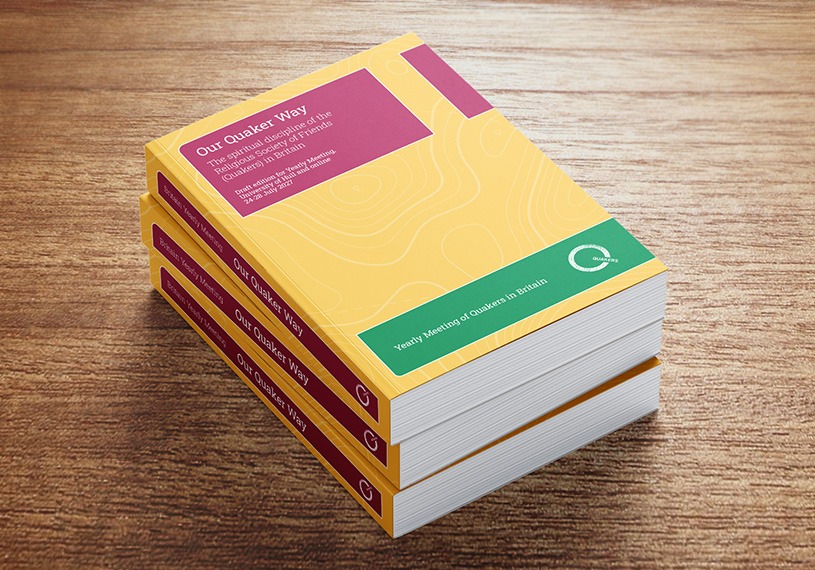
    Yearly Meeting on 21st November is the date that the draft of our new Book of Discipline is shared with the yearly meeting. Here are some useful resources to help your meeting read, reflect and respond.

    Meetings are asked to read, reflect and respond to the draft text for our new book of discipline.

    Consider how you might help Friends engage with the text and shape the final version. Will you read the text? Might your meeting set up a reading group to discuss some of the themes and chapters? Could you invite Woodbrooke to run a course for your meeting?

    Local and area meetings are asked to discern responses to the new text once their meeting is ready. What’s your role in the next stages of this journey towards a new book of discipline?

    Context: 

    Progress on the book of discipline: 

    • The revision process so far (video):

    How to get involved in the next stages: 

    Accessing Materials

    Materials will be made available on this post once they are live – but you will also be able to access them from the Yearly Meeting documents.

    • Online version of Our Quaker Way – this will be launched at Yearly Meeting
    • Physical copies – 2 copies will be sent to every local meeting, and will be available to purchase online. 
    • Audio – sample audio will be made available after yearly meeting 
    • Pathways – these are guided resources to help you explore themes in the book alone or in groups. They will be launched alongside the draft text.
  • Starting Again with Almost Nothing: Help a Man Leaving Prison This Christmas

    Starting Again with Almost Nothing: Help a Man Leaving Prison This Christmas

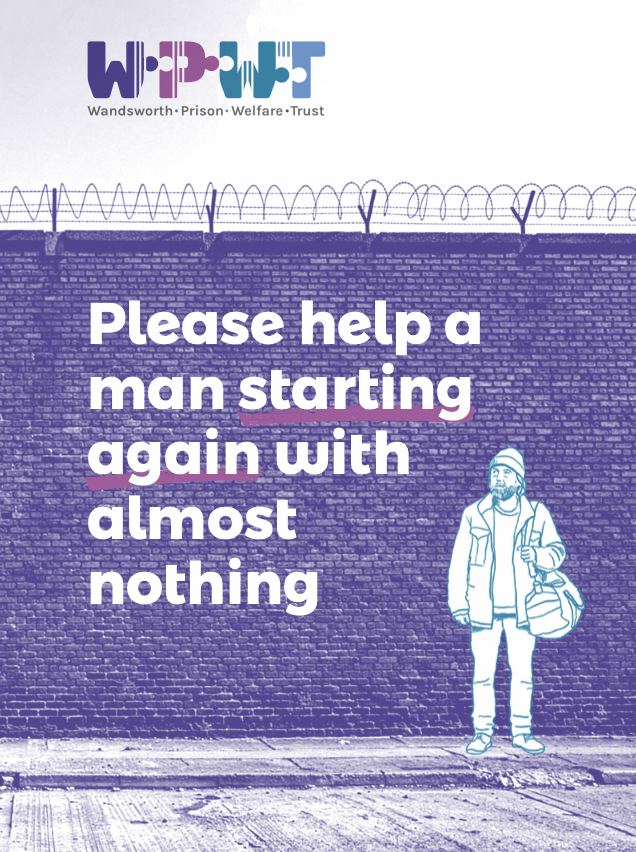
    Wandsworth Prison Welfare Trust is a charity which helps men in Wandsworth Prison. It is led by Quakers from Wandsworth meeting who have asked us to share information about their Christmas appeal.

    Imagine walking out of prison with nowhere to go, very little money and no one waiting for you. Now imagine doing it at Christmas, when everyone else is enjoying a holiday.

    For many men leaving Wandsworth Prison, this is what release day looks like.

    What release day really means

    Many men leave prison with only the clothes they wore on the way in, a small amount of soap and toothpaste, and hardly any cash. That may be everything they own. They have no warm coat, no suitable shoes, no phone, no travel card, no support network and no place to call home.

    Yet from the moment the gates close behind them, they are expected to start rebuilding their lives. They must contact probation services, arrange benefits, speak to housing teams, attend appointments, and try to avoid the circumstances that led them into prison in the first place.

    “I didn’t dare buy a coffee”

    Daniel, now a trustee of Wandsworth Prison Welfare Trust (WPWT), knows this first-hand. After nine months in Wandsworth, he was released with a one-way rail ticket home to Doncaster and vague directions for crossing a city he’d never visited. His clothes no longer fitted, he had no phone, and he had only a few pounds saved from his prison job.

    “I had to rely on strangers to direct me from Wandsworth to Kings Cross Station. I didn’t dare buy a coffee or a sandwich in case my money ran out.”

    Daniel was lucky: his family welcomed him home. Not everyone has that. As he puts it, small items like warm clothing or a mobile phone can make a huge difference in those crucial first few days.

    How WPWT helps

    WPWT helps men make the difficult move from prison to the community by providing:

    • Warm, waterproof clothing suitable for the season
    • Trainers and other basic clothing items
    • A loaded Oyster card, so they can travel to appointments and services
    • A simple, working mobile phone, so they can contact probation officers, social services, housing providers and benefits teams
    • A waterproof sleeping bag for those facing homelessness or sleeping rough

    These are not luxuries. They are the basic tools needed to survive, stay in contact with support services, and start building a stable future, rather than seeing a return to prison as the best option.

    The stakes are high: more than one man dies every day in the year after leaving prison.

    How you can help

    Any donation, large or small, helps someone take those first difficult steps. Here’s what your gift could do:

    • £10 could help provide basic toiletries and essential items
    • £25 could help provide warm clothing
    • £50 could help provide a mobile phone or travel support
    • £100 could help equip a man with clothing, transport and a simple mobile phone

    To donate or find out more about WPWT’s work, visit wpwt.org.uk.

    You can also help by sharing this post. Pass it on to friends, family, colleagues or your community group. The more people who hear about the appeal, the more men can be helped.

    A fresh start begins with the basics

    A warm coat, a working phone and a way to get to the first appointment can be the difference between despair and a real chance of starting again. Please help WPWT provide them.

    Wandsworth Prison Welfare Trust is a registered charity in England and Wales (1198674).

  • How can we use modern forms of communication to link up and get to know each other?

    How can we use modern forms of communication to link up and get to know each other?

    Article for Quill by Christine DG & Sam W, co clerks of the Arrangements Committee

    How can we use modern forms of communication to link up and get to know each other?

    We can put our Events onto the Quill listings by emailing quill@quakersinlondon.org. This will be visible on the Quakers in London website and included in the monthly email.

    For example you will find the link to the regular London-wide online worship on Friday evenings (7.30 – 8.30 pm). It is  followed by informal conversation. There are details for joining the monthly Quaker Ramble. 

    Some London-wide WhatsApp groups have started under the umbrella of a Quakers in London WhatsApp community.  There are a mixture of private groups for admin and social groups for chatting. There is an announcement channel where admins share upcoming events.

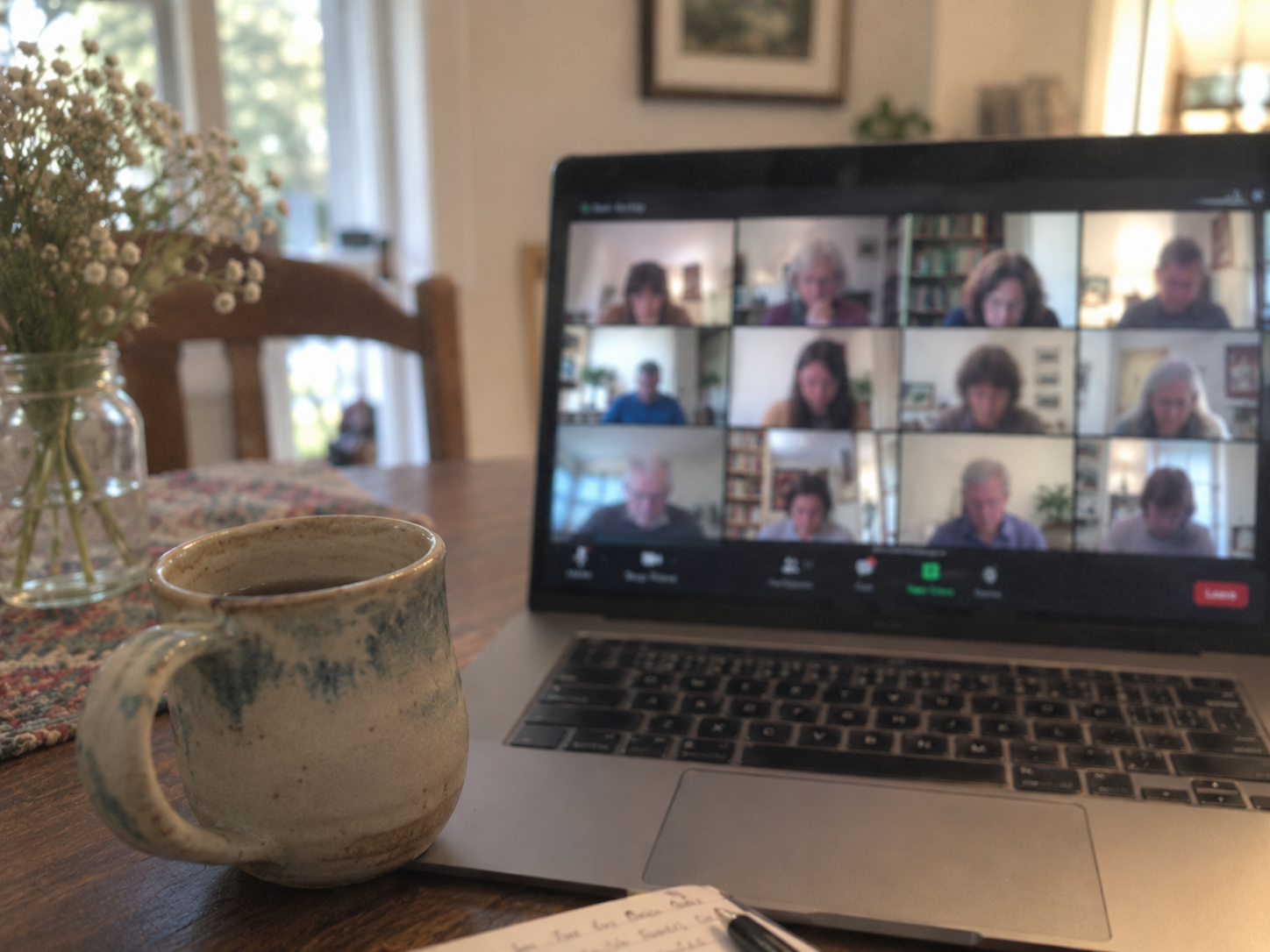
    One friend has set up a local group for over 80s using their own zoom account.  They meet once a month online for a discussion –  not particularly on Quaker topics. They are limiting the group to twelve participants.

    Anyone can arrange free 40 minute sessions on Zoom.

    The Arrangements Committee has a Zoom account.  The problem with it is that Zoom security codes go to one person who must be there to open the meeting.  In our case this depends on a small number of role holders or staff members.  We can set up meetings fairly easily for ourselves but Zoom does not want security codes shared. This could become a problem if other hosts across London wanted to set up meetings on the account.  Extra Zoom accounts would be costly.

    However, there is a useful alternative which Friends can access through our Area Meeting. A Google Meet account is free for charities and user accounts can be created within it via arrangements committe  The interface looks similar, as long as the host tells first timers where to find the ‘gallery’ viewing option (three vertical dots on the lower right, choose tiling). For Friends who would rather not have an account, they can ask admin@quakersinlondon.org to set up a one off or recurring meeting for their events.

    We strongly recommend that QiL AM uses Google Meet for committee work.  Zoom can continue to be used by people holding individual accounts but Google Meet accounts would be ideal for friends and attenders setting up Quaker interest groups.

  • Administration & Communications Co-ordinator

    Administration & Communications Co-ordinator

    Is your next professional role with the London Quaker community? Can you help us thrive?


    The role of Administration and Communications Co-ordinator with Quakers in London (QiL) will be London-based, full-time, and on a continuing contract.

    We are seeking someone with a proven talent for organisation who can:

    • make sure meetings and events run smoothly and that QiL communicates effectively, engaging with the full diversity of London Quakers and forging new relationships within and beyond the Quaker community;
    • support comprehensive, accurate record-keeping, in compliance with Quaker governance and GDPR.


    Deadline for Applications: 12 noon, Friday 13 November 2026
    First Round Interviews: Thursday 19 November (in person at Friends House, 173-177 Euston Road, London NW1 2BJ)

  • QiL Area Meetings: Finding Our Path

    QiL Area Meetings: Finding Our Path

    This is a short note from Arrangements committee (QiLAC):

    Dear Friends,

    We’ve had a few messages in our inbox asking about the regular pattern of our QiL Area Meetings as across London many of our worshipping groups start to think about setting dates for their own meetings in 2027. We provide this note with the hope it brings some clarity.

    QiL meets on the second weekend of alternate months. We ask that minutes from Local Meetings are received two weeks in advance to give enough time for our clerks to discern a suitable agenda for the meeting.

    We have created a new page on this website to try and capture all the information about our business meetings in one place: access to documents, dates of upcoming meetings, and the information I have just shared. You can find it here: https://quakersinlondon.org/business/

    As always, if you have any feedback or thoughts you’d like to share about the arrangments for our Area Meetings, QiLAC are listening! Please get in touch and let us know at arrangements@quakersinlondon.org.

    Your Friend,

    Sam

    On behalf of Christine, Daniel, Gerry & Gillian (Arrangements Committee)

  • Palestine ’36: Film Review

    Palestine ’36: Film Review

    This film review was submitted by a London Friend. Have you watched a film that you’d like to share with Quakers in London? Email quill@quakersinlondon.org to share it on The Quill.

    Directed by Annemarie Jacir, Palestine ’36 is set during the Arab Revolt of 1936–39 against British rule, a period most of us in Britain were never taught about. That absence from our education is uncomfortable in itself. It raises questions about whose histories we learn, whose suffering we recognise and how readily we confront the part Britain played in shaping the world we see today.

    The film doesn’t follow one hero. Instead, it moves between several households and communities, bringing villagers, rebels, townspeople and officials into the same unfolding events. What struck me most was how ordinary life feels at the beginning. People farm, argue, read the paper and worry about money. Jacir takes time to show us people living their lives before history sweeps them up, and because we have spent time with them, what happens later hurts all the more.

    One of the film’s real achievements is the way it makes a largely overlooked period of history feel immediate and human. The revolt is not presented simply as a series of political events or military confrontations, but as something that reaches into homes, relationships and everyday decisions. We see how people respond differently to growing injustice, how difficult choices become unavoidable, and how the consequences of political power are lived by ordinary people. The film also makes clear that Palestinian history did not begin with the events we might hear about most often today. It gives us a chance to understand something of the longer roots of Palestinian dispossession and resistance, and to see the people involved as more than symbols in a political argument.

    There is a strong sense of place, too. The landscape and villages feel integral to the story, not simply a backdrop against which history unfolds. Knowing that the film is set in Ramallah brought this closer to home for me. Ramallah is also home to the Ramallah Friends School, where Quaker educational work began in 1869, long before the events depicted in the film. This longstanding connection between Quakers and Palestine is a reminder that the region is not simply a subject of historical study or political debate. It is home to communities with their own histories, relationships and hopes for the future. The school’s existence also reminds us that these connections have endured through periods of profound upheaval.

    The film tells this history firmly from a Palestinian point of view, bringing to the foreground experiences and perspectives that have too often been marginalised in Britain. For me, that is part of what makes it valuable. It asks us to pay attention to a history we may know very little about, and to consider what we might have missed by not knowing it. It also made me think about this year’s Salter Lecture, The Middle East: a moral catastrophe?, delivered by Rachel Shabi. Her reflections on the erosion of international law and the failure to uphold universal human rights consistently resonate with the questions raised by the film. Both invite us to look beyond immediate events and consider the histories and choices that have shaped the present. They also challenge us to ask whose experiences are recognised, whose suffering receives attention, and whether we apply our moral principles consistently, even when doing so means confronting our own country’s history.

    As a Friend, the film made me think about what it means to bear witness. The Quaker peace testimony is not simply an opposition to war; it asks us to look at the conditions that make violence possible, to recognise the humanity of those caught up in it, and to resist the idea that suffering is inevitable or somehow deserved. The testimonies to truth and equality matter here, too. Truth asks us to face histories that may unsettle our own national story, while equality challenges us to consider whose lives, voices and losses are given weight. These are principles that must be applied consistently, rather than according to political convenience or familiarity. Watching Palestine ’36 felt like a reminder that bearing witness begins with being willing to look, to listen and to learn, even when what we encounter is difficult. It also raises the question of what responsibility follows from knowing more than we did before.

    So, would I recommend it? Yes. It makes a neglected history accessible without losing sight of the people who lived through it. If you know little about the 1936 revolt, it is a worthwhile place to begin. If you already know the history, it offers a moving opportunity to sit with its human consequences. It invites us to reflect on our own country’s past, on the stories we have inherited or ignored, and on what peace, truth and equality ask of us now.

  • Link Weekend in Watford

    Link Weekend in Watford

    Submitted by London Link Group

    From 9th to 11th October, 36 young people and 7 volunteers gathered at Watford Quaker Meeting House for a London Link Group weekend, the group’s first visit since 2013.

    Highlights included baked potatoes for 47, a build-your-own “Quaker Subway” lunch, newspaper hockey, mafia, board games and a firepit epilogue in the Meeting House garden. On Saturday, Michael led a session on Nonviolent Communication and how it can help put the Peace Testimony into everyday practice, and on Sunday those who wished joined Meeting for Worship.

    Everyone went home a little tired, but with friendships nourished and hearts heartened.

    Read the full report on the London Link Group blog →

  • Being Quaker – A Four Week Course for Newcomers

    Being Quaker – A Four Week Course for Newcomers

    The being Quaker Course is an opportunity to explore key themes within the Quaker Way. Each session will involve discussion and opportunities for questions as well as input from experienced Friends.  There is no cost and anyone is welcome.

    Dates: 22nd & 29th October, 5th & 12th November

    Time: 7:15-9:15pm

    Location: Streatham and Brixton Quaker Meeting (close to Streatham station.)

    Topics will include:

    • Quaker worship and ministry
    • Quaker history and future
    • How Quakers make decisions and structure themselves
    • The testimonies and living a Quaker life

    To book your place, email beingquaker@londonquakers.org.uk

    Please also make any newcomers in your own local meeting aware of this opportunity.

    Have you attended a Being Quaker course? If you would like to share your experience, we would love to hear from you! You can write to us at quill@quakersinlondon.org to share your experience with Friends across London.

  • Learning from our past as we build our future: when Six Weeks Meeting became LQPT

    Learning from our past as we build our future: when Six Weeks Meeting became LQPT

    At a time of significant change for our Area Meeting structures, the former Clerk of Six Weeks Meeting reflects on a previous period of transition: when Six Weeks Meeting became London Quakers Property Trust.

    Six Weeks Meeting (SWM) was registered as a company limited by guarantee in 2009, and the name was changed to London Quakers Property Trust (LQPT) in 2017. The trustees of SWM chose this legal framework because there was no other option at the time; registering it as a Charitable Incorporated Organisation wasn’t possible until 2013. This was also the clear advice of our solicitors, Russell Cooke. 

    SWM had been set up by George Fox in 1671 and continued for over 300 years with no legal status. Britain Yearly Meeting (BYM), like many old-established religious bodies, had excepted charitable status and had no charity number. Because several religious bodies and charities misused their funds in the 1980s, the government rightly decided that all religious bodies and charities had to be legally established, registered, and under the eye of the Charity Commission, so BYM itself, all our Area Meetings, and SWM, had to regularise their status.  Setting up LQPT took years of work from trustees and staff – days in the Library checking all the historic deeds of every meeting house, many many meetings with solicitors, letters and phone calls to and from the Charity Commission, consultations with AMs, trustee meetings, and hours and hours drafting snd re-drafting minutes so that the new Trust was soundly based.  We felt that whatever changes might come to LQPT in the future, this gave it a solid foundation. 

    If now in 2026, we in London had decided to set up a CIO from scratch, we would have been asking for years of voluntary work and high solicitors fees. The Charity Commission was fairly slow in my time; it now has more work and fewer staff, so the process would be even slower. It will be for QiL and QiL trustees to discern whether changing the legal status to become a CIO is worth the effort at some time in the future, recognising that it will be a long-drawn-out process.

    Submitted by a Former Clerk to Six Weeks Meeting

  • Transferring Membership to QiL

    Transferring Membership to QiL

    LDG have provided an update on Friends’ progress in transferring their membership to Quakers in London. If you haven’t recived your membership transfer email, please contact membership@quakersinlondon.org.

    On 20 September, some Friends in Membership of one of the 7 AMs in London were the first to fill in a form requesting to transfer their membership to Quakers in London (QiL) at the end of the year. By 1 October, more than 500 Friends (53% of those in Membership of one of the AMs) had already completed the paperwork.

    This article is for those who haven’t yet completed the process because they are having problems with the form filling, or worried about the implications of joining QiL.

    Through discernment over many years within each of our AMs and, more recently, working together as the Joint London Area Meeting (JLAM) every AM has agreed to become part of QiL Area Meeting at the beginning of 2027, and to formally close the current AMs soon after.

    You need to actively agree to transfer into QiL just as you would leave one AM and ask to join another if you moved to another part of England. Quakers in Britain hold membership at AM level (not at Yearly Meeting or Local Meeting) so – by the time your old AM closes – you need to have agreed to join QiL or you won’t be in membership anywhere. In effect, you will have resigned your membership.

    We hope you will all agree to transfer, but it is your decision.

    Every AM within Britain Yearly Meeting is a charity and that’s necessary so that they can own meeting houses and hold AM or LM bank accounts. Some are Charitable Incorporated Organisations and some are Charitable Companies. In October 2025, JLAM (with the minuted authority of each AM) opted to take over LQPT’s current charitable registration (Minute JLAM 25/19), which is legally structured as a Charitable Company. You can find the whole minute here. As a result, the legal governing document, which is called the Articles of Association, has been updated to suit Quakers in London rather than LQPT. You can read more about the Articles of Association here and see the final draft here.

    When you transfer into QiL you become a member of that Charitable Company as well as a member of the AM in Quaker governance terms. As an Area Meeting and a worshipping community, how QiL works will be governed mainly by Quaker Faith and Practice chapter 4 and by the QiL terms of reference and other documents that we develop ourselves. We will also need to follow the Articles of Association for certain technical issues. There is no risk to members of the Charitable Company because it is ‘limited by guarantee’ – and the only potential liability is to pay ‘up to £1’ in the extremely unlikely event that the charity were to close with debts.

    In the words of Beth Allen from Bromley Meeting ‘We need to be an ordinary well-run organisation, with good structures and sensible practices, which we then make extraordinary by transcending, not discarding them.’ Qf&p 8.25

    Whichever type of charity JLAM had chosen, you would have had to complete a form to transfer. And the form gives you a chance to say what information you want to receive and whether you want to be included in a directory available to other members.

    If you decide that you don’t want to join QiL then you can do most things as an Attender, but we hope that you will be part of our London-wide AM as a Member.

    If you want to complete the form and don’t know what to do, don’t worry:

    • If you’re in Membership of one of the London AMs and haven’t received a personalised email with your form, send a message to Chris Martin (Assistant Clerk Membership) at membership@quakersinlondon.org and he will sort it out.
    • If you’re not sure how to fill in your form online, maybe someone in your LM can help?
    • If you – or someone you know – needs a hard copy, message Chris (membership@quakersinlondon.org) and he can give you a hard copy.

    Chris and others are happy to come and visit anyone at home who would like to talk all this through or get some help. The important thing is that everyone who wants to transfer their membership, does so. Ideally this should be completed by the end of the year, but we’ve found a way to make it possible to transfer latecomers in the early part of 2027 too.

    Please trust the discernment of the last eight years, ‘Live Adventurously’, fill in the form and transfer your membership.

    The London Development Group